معیار کِلی و رولت
معیار کلی به کسی که با برتری شرط میبندد میگوید چقدر شرط ببندد. برای رولت پاسخ روشنی میدهد: هیچ.

مبلغ شرط کلی = برتری / شانس. با برتری منفی، فرمول کسری منفی برمیگرداند، یعنی شرط نبندید. این معیار همچنان برای فهم اینکه بازیکنان سوگیری چرا شرطهایشان را آنگونه اندازه میگرفتند، و چرا بقیه باید اندازه شرط را از بودجه بگیرند، سودمند است.
معیار
John Kelly (1956) asked how a gambler with a known edge should size bets to maximize long-run growth of the bankrollپولسرمایه بازیکل مبلغی که برای بازی کنار گذاشته شده است. مدیریت سرمایه بازی یعنی تصمیمگیری درباره مقدار ریسک آن در هر شرط و هر جلسه.خواندن کامل ←. The answer, for a bet paying b to 1 with win probabilityریاضیاحتمالشانس یک نتیجه، از 0 تا 1 یا از 0% تا 100%. یک شماره: 1/37 = 2.70%.خواندن کامل ← p and loss probability q = 1 − p, is to stake the fraction f* = (bp − q) / b of the bankroll. Positive f* means bet that fraction; zero or negative means do not bet. Kelly worked at Bell Labs, and his paper, “A new interpretation of information rate”, set the problem in Claude Shannon’s theory of information: a gambler who gets tips over a noisy line, at fair odds, can grow the bankroll at best at the rate the line carries information. This is a growth objective under a probability model, not a promise to finish ahead after a particular number of bets. A spending limit, finite deadline or payoutپولپرداختآنچه شرط برنده بازمیگرداند، با عبارت «X به 1» افزون بر بازگشت مبلغ شرط.خواندن کامل ← cap changes the decision problem.
شرطبندی کلی در رولت
For redشرطقرمزشرط پولبرابر روی 18 شماره قرمز. فرانسوی: rouge.خواندن کامل ←: b = 1, p = 18/37, q = 19/37; f* = (18/37 − 19/37)/1 = −1/37. For a straight upشرطتکعددیک شماره، با پرداخت 35:1.خواندن کامل ←: b = 35, p = 1/37, q = 36/37; f* = (35/37 − 36/37)/35 = −1/1295. Every standard bet gives a negative Kelly fraction, because every bet has a negative edge, and the growth-optimal stake is zero. Kelly betting on roulette is a formal way of saying what the house-edge page says: no positive stake maximizes expected logarithmic growth when the bet has negative expectation. A particular session can still end in profit. La partageقانونلا پارتاژقانون فرانسوی: وقتی صفر میآید، نیمی از مبلغ شرط پولبرابر بازگردانده میشود. برتری کازینو در آن شرطها را به 1.35% نصف میکند.خواندن کامل ← needs a separate three-outcome calculation: a win, a full loss or a half-loss on zeroچرخصفرخانه سبز تکی که هیچ شرط پولبرابر، دوجین یا ستونی آن را نمیپوشاند؛ سرچشمه برتری کازینو. نامهای دیگر: صفر تکی، 0.خواندن کامل ←. Its expected log growth also falls as the stake increases from zero.
| شرط | b | p | f* = (bp − q)/b | معنا |
|---|---|---|---|---|
| قرمز، اروپایی | 1 | 18/37 | −0.027 | شرط نبندید |
| قرمز، لا پارتاژ | سه نتیجه | 18/37 برد؛ 1/37 باخت نیمی | فرمول دودویی کاربرد ندارد | مبلغ شرط بهینه برای رشد: 0% |
| تکعدد | 35 | 1/37 | −0.00077 | شرط نبندید |
| تکعدد روی خانهای با نرخ 1/30 (سوگیر) | 35 | 1/30 | +0.0057 | 0.57% سرمایه بازی را شرط ببندید |
| تکعدد روی خانهای با نرخ 1/25 | 35 | 1/25 | +0.0126 | 1.26% سرمایه بازی را شرط ببندید |
جایی که کلی واقعاً به کار آمد
Suppose a pocketتجهیزاتخانهیکی از 37 محفظه شمارهدار روی روتور. نامهای دیگر: شیار، جام.خواندن کامل ← really has a stable, known probability of 1 in 30 and pays 35 to 1. The Kelly fraction is 0.57%: about $57 from a $10,000 bankroll. Under independent spinsریاضیچرخشهای مستقلهر چرخش صرفنظر از تاریخچه، احتمالهای یکسان دارد. پایه هر محاسبه این سایت.خواندن کامل ← and exact fractional staking, the geometric growth factor over 1,000 spins is about 1.7. Expected bankroll grows faster because rare large wins pull up the average. These are model calculations, not evidence that any named historical player used Kelly or achieved this result.
معمول و میانگین
The gap between the typical bankroll and the average one is wide. Take a pocket that hits 1 time in 25, a hypothetical edge of 44% per unitپولواحدمبلغ شرط پایهای که یک سیستم یا بازیکن با آن کار میکند. تصاعدها با واحد توصیف میشوند تا در هر میزی کاربرد داشته باشند.خواندن کامل ← staked. Kelly stakes 1.26% of the bankroll on it. After 1,000 spins the typical bankroll has grown about 11.5 times, while the average, pulled up by a few very lucky runs, has grown about 249 times. Betting more than Kelly raises the average and lowers the typical result: at twice the Kelly stake the typical bankroll only doubles, and by two and a half times the Kelly stake it shrinks, although every bet still carries a 44% edge. In this example, half-Kelly retains about 78% of the expected log growth. This fraction depends on the probabilities and payout.
| مبلغ شرط، سهم از کلی | مبلغ شرط، % سرمایه بازی | سرمایه بازی معمول پس از 1,000 چرخش |
|---|---|---|
| ½ | 0.63% | × 6.7 |
| 1 | 1.26% | × 11.5 |
| 1½ | 1.89% | × 7.4 |
| 2 | 2.51% | × 2.2 |
| 2½ | 3.14% | × 0.38 |
| 3 | 3.77% | × 0.04 |
وقتی برتری یک حدس است
Kelly uses the true probabilities, but a player usually has only estimates. Selecting the busiest pocket from a past record creates a selection problem: even a fair wheel has a busiest pocket. Its observed rate can overstate its future probability. Choosing the stake from that same record compounds the error. An independent follow-up sample helps test a proposed bias (see How to Detect Roulette Wheel Bias). Reducing the calculated fraction reduces exposure, but cannot turn a false edge into a real one.
آدمهایی با برتری
Haghani and Dewey (2016) studied 61 participants given $25 and 30 minutes to bet on a simulated coin with a disclosed 60% chance of heads. The payout cap was $250; its value was revealed when a proposed winning bet would reach it. Their reported 21% success category included balances of at least $200, while the 28% “bust” category meant less than $2, not necessarily zero. Eighteen participants bet their entire balance on one flip. The uncapped Kelly fraction is 20%, but the cap and deadline change the optimization problem. The experiment illustrates how stake choices matter even with a known advantage; it does not establish one best strategy for every objective.
به جای آن از چه استفاده کنیم
بدون برتری، اندازه شرط پرسشی درباره بودجه است، نه درباره رشد: مبلغ شرط = آنچه حاضرید در هر چرخش خرج کنید، که از بودجه ساعتی و سرعت میز به دست میآید (صفحه مدیریت سرمایه بازی رولت). سهم کلی برای بازیکن عادی روشنی پاسخ آن است: صفر. هر مبلغی که بالاتر از صفر شرط میبندید بهای بازی است، که خودتان انتخابش کردهاید، نه اینکه فرمولی آن را بهینه کرده باشد.
نکتهای درباره کلی کسری و «مدیریت پول»
Betting a fixed percentage of the current bankroll is proportional staking: the stake rises after wins and falls after losses. Flat bettingراهبردشرط ثابتشرطبستن با مبلغ یکسان در هر چرخش. مبنایی که هر تصاعد با آن مقایسه میشود.خواندن کامل ← instead keeps the cash stake fixed. Neither creates an edge on ordinary roulette. With infinitely divisible stakes and a fraction below 100%, proportional staking never reaches exactly zero in finitely many losses, but the balance can become arbitrarily small. Real table minimums can prevent further play much sooner. The growth-optimal fraction remains zero.
فرمول
پرسشها
Only when the actual probabilities, payouts and conditions give a credible positive advantage. Standard bets on an unbiased wheel have no such advantage.
Using half the calculated fraction reduces exposure to errors in the estimated edge. The familiar three-quarters-growth rule is an approximation for small advantages, not a universal identity. It does not protect against an edge that does not exist.
نه. کلی با فرض داشتن برتری رشد را بهینه میکند. مدیریت سرمایه بازی بدون هیچ برتری خرج را کنترل میکند.
سرگرمی با ریاضی
اول خودتان امتحان کنید. هر راهحل بسته است؛ هر وقت آماده بودید بازش کنید.
Suppose a hypothetical bet on one number has a known 44% edge under standard payoutsپولپرداختآنچه شرط برنده بازمیگرداند، با عبارت «X به 1» افزون بر بازگشت مبلغ شرط.خواندن کامل ← and independent spinsریاضیچرخشهای مستقلهر چرخش صرفنظر از تاریخچه، احتمالهای یکسان دارد. پایه هر محاسبه این سایت.خواندن کامل ←. Kelly gives a 1.26% bankrollپولسرمایه بازیکل مبلغی که برای بازی کنار گذاشته شده است. مدیریت سرمایه بازی یعنی تصمیمگیری درباره مقدار ریسک آن در هر شرط و هر جلسه.خواندن کامل ← fraction. What if the same 44% edge came on one bet spread over five neighboring numbers?
نمایش راهحل
پاسخ آنگاه کلی میگوید 7.1% از سرمایه بازی، و سرمایه تقریباً شش برابر سریعتر رشد میکند: در 1,000 شرط حدود 1.25 میلیون برابر، در برابر حدود 11.5 برابر.
A straight upشرطتکعددیک شماره، با پرداخت 35:1.خواندن کامل ← with a 44% edge wins with chance 0.04, since 36 × 0.04 = 1.44. Kelly’s stake is the edge divided by the odds: 0.44/35 = 1.26%. The typical growth per bet is 0.04 × ln(1 + 35 × 0.0126) + 0.96 × ln(1 − 0.0126) ≈ 0.00244, so 1,000 bets multiply the bankroll by about e^2.44 ≈ 11.5.
Spread one stake over five numbers and the bet wins with chance 0.20 and pays 36/5 for 1, that is 6.2 to 1: still a 44% edge, since 0.2 × 7.2 = 1.44. Kelly’s stake becomes 0.44/6.2 = 7.10%, and the growth per bet 0.01404, about 5.75 times as much. Over 1,000 bets that is e^14.04, about 1.25 million.
The edge is the same; the swings are smaller. A bet that wins one time in five has a larger growth-optimal fraction in this model, although losses can still reduce the bankroll severely. This comparison assumes the same known edge for both bets; actual predictions need independent evidence.
Assume two numbers are adjacent on the betting layoutتجهیزاتچیدمانشبکه شرطبندی چاپشده روی میز. نامهای دیگر: میز، نمد، پارچه.خواندن کامل ← and each has a stable, known probabilityریاضیاحتمالشانس یک نتیجه، از 0 تا 1 یا از 0% تا 100%. یک شماره: 1/37 = 2.70%.خواندن کامل ← of 1 in 25 on independent spins. Compare a splitشرطدوتاییدو شماره مجاور، با پرداخت 17:1.خواندن کامل ← between them at 17 to 1 with equal straight-up stakes on the two numbers. How much does Kelly say, and how fast does the bankroll grow compared with one such pocketتجهیزاتخانهیکی از 37 محفظه شمارهدار روی روتور. نامهای دیگر: شیار، جام.خواندن کامل ←?
نمایش راهحل
پاسخ فرقی نمیکند: 2.59% از سرمایه بازی روی دوتایی، یا 1.29% روی هر شماره. سرمایه معمول در 1,000 چرخش حدود 155 برابر میشود، در برابر 11.5 برابر با یک خانه.
The split wins with probability 2/25 = 0.08 and pays 17 to 1, so it returns 18 × 0.08 = 1.44 per unitپولواحدمبلغ شرط پایهای که یک سیستم یا بازیکن با آن کار میکند. تصاعدها با واحد توصیف میشوند تا در هر میزی کاربرد داشته باشند.خواندن کامل ← staked: an edge of 44%, the same as one biased pocket. Kelly’s stake is the edge divided by the odds: 0.44/17 = 2.59%.
Two straight-up bets of 1.29% each give exactly the same results. When either number comes up, one chipپولژتوننشانهای نماینده مبلغ ثابت که برای شرط روی چیدمان گذاشته میشود. نام دیگر: چک.خواندن کامل ← wins 35 to 1 and the other is lost, a net of 34 × 1.29% = 44% of the bankroll, as the split pays; when neither does, both are lost.
The growth per spin is 0.00505, against 0.00244 for one pocket, so over 1,000 spins the typical bankroll grows e^5.046 ≈ 155 times rather than e^2.44 ≈ 11.5 times. The geometric growth factor is larger because the combined bet wins more often at the same 44% edge. It is a model result, not a guaranteed bankroll.
چاشنی طنز
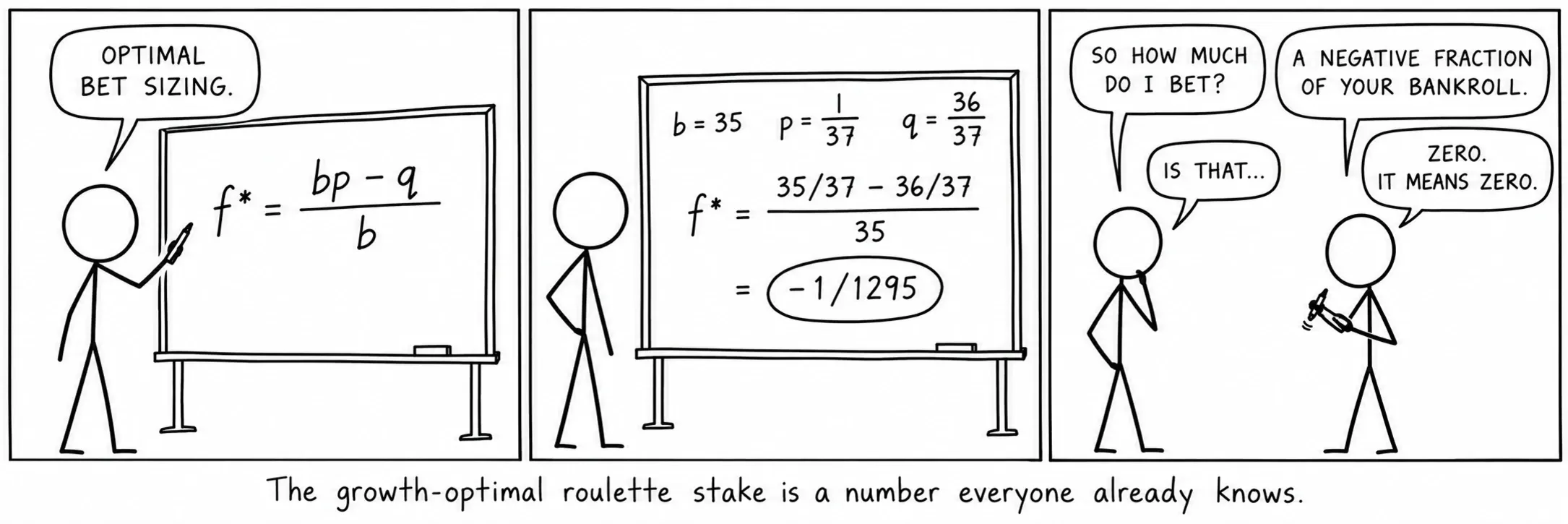
مبلغ شرط بهینه برای رشد در رولت عددی است که همه از قبل میدانند.
منابع
- Kelly, J. L. “A new interpretation of information rate.”
- Breiman, L. “Optimal gambling systems for favorable games.”
- Thorp, E. O. “Optimal gambling systems for favorable games.”
- Thorp, E. O. The Mathematics of Gambling.
- Epstein, R. A. The Theory of Gambling and Statistical Logic, 2nd ed.
- Taylor, D. G. Games, Gambling, and Probability: An Introduction to Mathematics, 2nd ed.
- Ethier, S. N. The Doctrine of Chances: Probabilistic Aspects of Gambling.
- Haghani, V. & Dewey, R. “Rational decision-making under uncertainty: observed betting patterns on a biased coin.”